
Traffic noise in general
Road noise consists of three noise components:
- Drive noise – Sounds from the engine, transmission, and exhaust
- Rolling noise - Sound generated by the interaction between tires and road surface
- Wind turbulence noise – Sound created by air turbulence around the vehicle chassis.
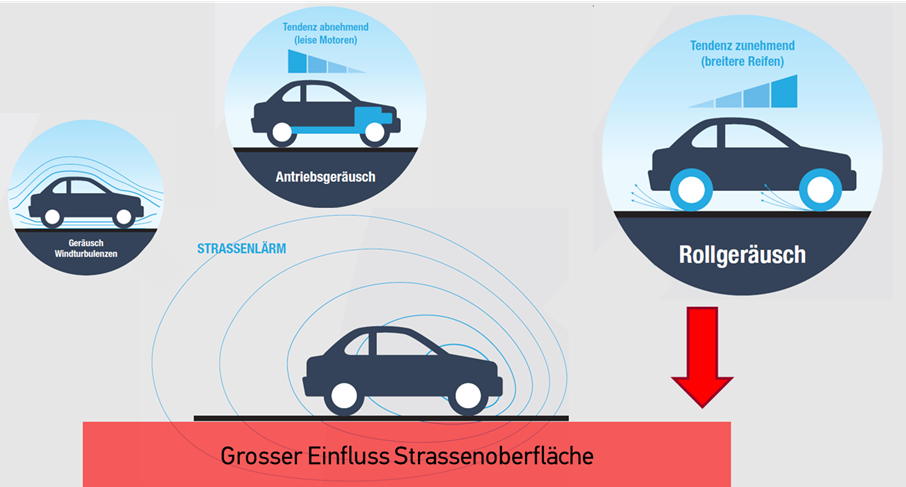
Influence of road surface on the generation of road noise for speeds above 30 km/h; size of the pictograms depending on their contribution to the total sound energy (Source: (Federal Office for the Environment BAFU, 2012), adapted Grolimund + Partner AG)
The illustration shows the various sound generation mechanisms for road noise and their development trends in recent years. For example, significantly quieter engines are used today than 30 years ago. The increasing electrification of the vehicle fleet leads to significantly reduced drive noises (at least in the higher speed range without AVAS*). In contrast, rolling noise has increased in recent years due to the generally wider tires. In addition to tire width, larger and thus heavier vehicles are responsible for the increase in rolling noise1.
Studies have shown that rolling noise in passenger cars dominates at a constant driving style from a speed of about 16 km/h (Hammer et al., 2016)2. For trucks, this is the case depending on the vehicle class at speeds of about 42 km/h (Heutschi and Locher, 2018a)3. For other vehicle types (tractors, motorcycles, and construction machinery), it is expected that the crossover speed (the speed at which the proportion of rolling noise exceeds the proportion of drive noise) is higher than for trucks or that drive noises dominate at all speeds. Similarly, very loud vehicles (sports cars, modified or tuned vehicles, etc.) often have drive noises dominating at all speeds.
The dominance of rolling noise even at low speeds shows the significant influence of the road surface. The following illustration shows the proportions of drive and rolling noise in the total sound energy emitted depending on the speed. These proportions are strongly dependent on the traffic mix and the installed pavement. For modeling with mixed traffic (8% heavy traffic share) and conventional pavement, the road noise model sonROAD18 was used. It shows that at 50 km/h, about 87% of the sound energy comes from rolling noise. Consequently, both in urban areas (at posted speeds of 50 km/h and 30 km/h) and in rural areas and on highways, quiet pavements are an effective noise protection measure.
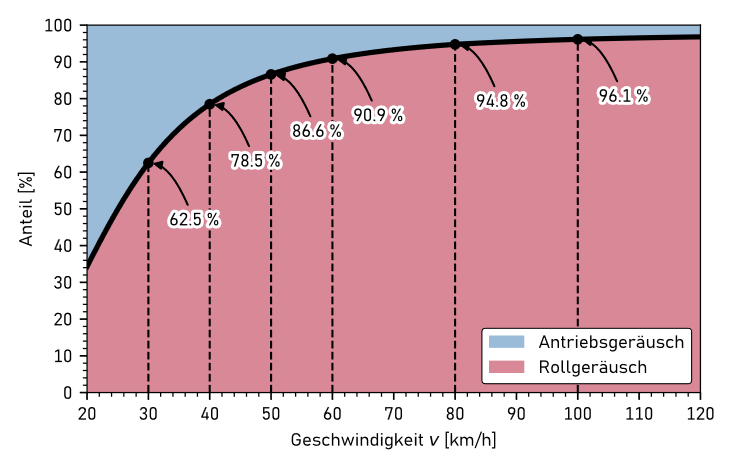
Ratio of rolling noise to drive noise, calculated with the noise calculation model sonROAD18 for 8% heavy traffic share and KB-0 pavement (Heutschi and Locher, 2018b4).