
Functionality of SDA Pads
A good noise-reducing surface has a fine surface texture and easily accessible surface pores. A fine surface texture minimizes vibration noise while surface pores reduce air flow noise. Accessible cavities in the surface also act as sound absorbers, leading to a reduction in the horn effect. The effects and functioning of SDA surfaces are illustrated in the following figure. The overall noise from the interaction between tires and the road consists of vibration noise, cavity resonances, air flow noises, and the horn effect.
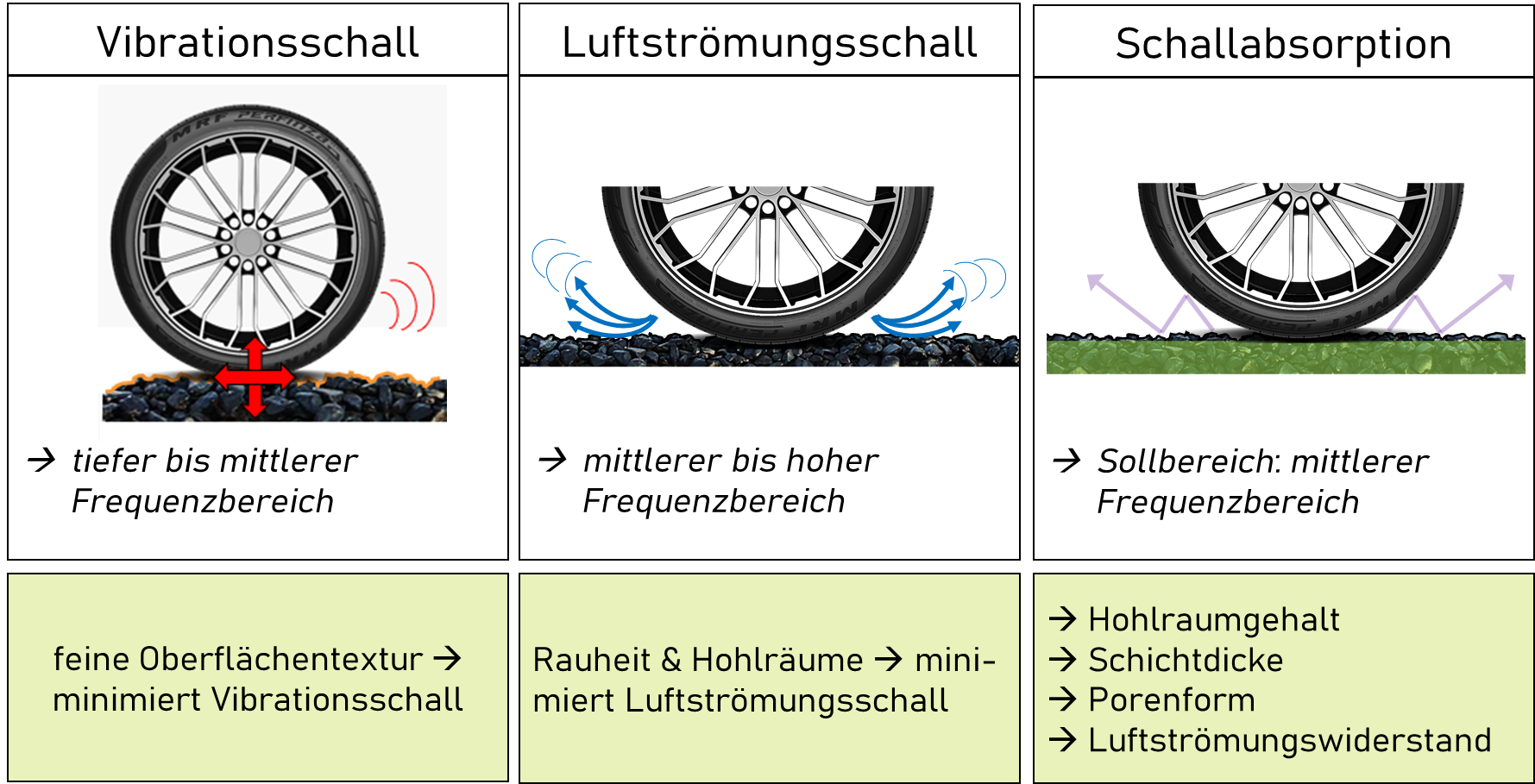
Functioning of quiet road surfaces (Source: Grolimund + Partner AG)
Reduction of vibration noise: the surface characteristics of the road surface influence its acoustic quality. A fine surface excites the vehicle tires less, which reduces vibration noise. At the same time, reduced excitation also leads to fewer cavity resonances in the tire. In general, it holds that concave textures excite the tires to a lesser extent than convex textures. Strongly convex textures usually lead to an increase in vibration noise due to enhanced excitation of the tire when rolling over.
Reduction of air flow noise: the specific air flow resistance describes how easily air can escape from or be drawn into the contact zone between tire and road. The lower the air flow resistance, the easier this can happen, leading to a decrease in air flow noise. A lower air flow resistance can be achieved by optimizing the surface texture (with a certain degree of surface roughness) or by the presence of interconnected cavity pores in the road surface. In acoustic texture optimization of road surfaces (without significant cavities in the surface), good ventilation properties can be achieved through both negative textures (e.g., ACMR) and fine positive textures (e.g., cast asphalts, fine surface treatments), as various measurements and modelings have shown.
Sound absorption: the sound absorption properties of a road surface are highly frequency-specific and depend on its layer thickness, porosity, pore shape, as well as their degree of interconnection and the specific flow resistance. The sound absorption properties of a road surface can have a significant impact on the extent of the horn effect and on sound propagation. Their measurement is of great importance in the detailed analysis of the acoustic effectiveness of semi-dense and porous surfaces.
The sound-absorbing properties of a road surface are best when a high sound absorption rate is achieved in the frequency range where the most sound energy is generated when the road surface is rolled over by vehicle tires. This typically occurs in the mid-frequency range between 800 Hz and 1250 Hz.