
Acoustical evaluation
Acoustical evaluation forms the core of the performance monitoring of low-noise SDA surfaces. It serves to quantify the actual noise reduction effect achieved in operation and to track the acoustic development over the service life.
Objective and Importance
The aim of the acoustic evaluation is to ensure that the installed surface meets the required noise reduction potential in the long term.
These are legally applicable noise reduction levels that are set in the context of noise remediation or new construction projects and must be permanently ensured by the road owner.
The results serve clients, specialists, and researchers as a basis for assessing material quality, optimizing construction and maintenance strategies, and evaluating the sustainability of low-noise road surfaces.
CPX Measurement Method (Close-Proximity)
The CPX method 1 2 3 is the central instrument of the acoustical evaluation.
It measures the noise development directly in the contact area between tire and road surface and allows for an objective, reproducible assessment of the acoustic quality of the surface.
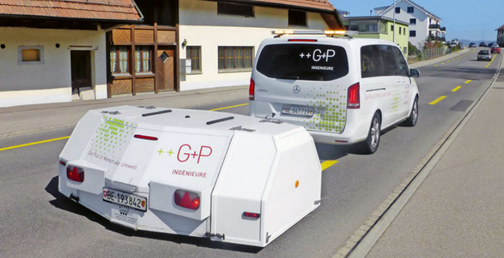
Advantages:
-
Comprehensive measurement of entire surface sections or network routes.
-
High comparability between different construction phases, surface types, and service life stages.
-
Used for both acceptance measurements and monitoring programs.
- Monitoring over time: capturing acoustic aging and the effects of maintenance measures (cleaning, grinding).
- Comparison of segments: assessment of different construction methods, materials, or installation procedures.
With CPX measurements, both initial acoustic properties after installation and changes over time (e.g., due to aging, pollution, or grinding measures) can be precisely captured.
Depending on the questions, several accuracy levels are available according to SN EN ISO 11819-24:
| Acceptance Measurements | Checking compliance with contractually defined criteria, research purposes | highest accuracy requirements |
| Monitoring Measurements |
Monitoring changes over time, quality controls, comparison of different technologies |
medium accuracy requirements |
| Condition Assessments |
Comprehensive current condition of acoustics and identification of deviating surfaces |
lowest accuracy requirements |
SPB Measurement Method (Statistical Pass-By)
The SPB method5 complements the CPX method, especially for new asphalt technologies or pilot routes.
While CPX measures noise emission in the close range, SPB captures the actual noise impact in the vicinity of the road and thus assesses the real influence on the residents.
-
The SPB measures the pass-by noise of individual vehicles at a fixed location.
-
This reflects the statistical effect of the surface in the current traffic mix.
-
It is particularly suitable for validating CPX results.
Areas of Application:
- Acceptance of new surfaces: evaluation of initial acoustic quality (in dB(A)) and relevance for the statistical vehicle mix.
Supplementary Methods
In addition to CPX measurements, air void, permeability, or texture measurements can provide additional information about the condition of the surface. This combination allows for a holistic assessment of acoustic, structural, and functional performance.
Through acoustical analyses, the contributions of various noise generation mechanisms can be detailed and identified. This can explain the real causes of different acoustic effects and different acoustic aging behaviors. Effect analyses provide answers and a basis for acoustical improvements of future pavements.