
Expected acoustic effects
For a surface to be considered low-noise in Switzerland, it must achieve a noise reduction of at least -1 dB(A) over its entire lifespan and an initial noise reduction of -3 dB(A) according to VSS 40 425 Noise-Reducing Pavements - Fundamentals1. To be regarded as a low-noise surface with significant effect, a noise reduction of -3 dB(A) over the entire lifespan and an initial noise reduction of -6 dB(A) must be achieved (see table below). The figure below shows the expected long-term acoustic effects of SDA 8 and SDA 4 pavements.
Categories of noise reduction from VSS 40 4252
| Category | State of the Art | Effect after Installation | Effect after 5 Years | Effect at the End of Acoustic Lifespan |
| III | Vision | -9 dB | -4 dB | -3 dB |
| II | Promising | -6 dB | -3 dB | -2 dB |
| I | Proven | -3 dB | -1.5 dB | -1 dB |
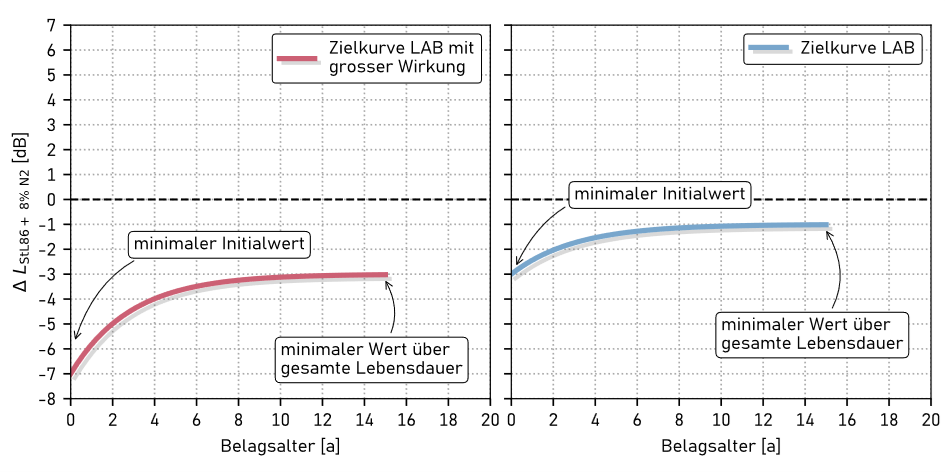
Acoustic Long-Term Behavior SDA 4 (left red) and SDA 8 (right blue) according to VSS 40 425 (Swiss Association of Road and Traffic Professionals VSS, 2019a).
The acoustic effect of SDA pavements decreases, as with all other pavements, with increasing age due to traffic load and other environmental influences. The following two processes play a significant role:
- The pores, which are so important for sound absorption, become increasingly clogged due to dirt entry, and the accessible cavities gradually close. This leads to an increase in tire-road noise in the mid and high frequency range.
- The pavement becomes rougher due to chip breakage, and the surface texture changes. This leads to an increase in tire-road noise in the low frequency range.
Learn more about the acoustic effects of LAB in combination with speed 30
On heavily noise-polluted roads, the two measures SDA pavement and speed 30 can be combined. For the calculation of the acoustic effect of both measures, it should be noted that the proportions of drive noise and engine noise change depending on speed (see Road Noise in General).
On behalf of the BAFU and in collaboration with the Kt. AG, extensive measurements of noise emissions, traffic composition, and actual speeds were conducted at five locations with existing SDA pavement for one to two weeks. During this time, the signaled speed was reduced from 50 km/h to 30 km/h over at least three days. On another stretch in the city of Lucerne with conventional asphalt, reference measurements could be conducted thanks to a planned permanent re-signaling. This made it possible to measure under real conditions what road noise emissions actually occur in practice.
Based on this traffic-normalized data basis, an empirical calculation method was developed to estimate the noise effect of a speed reduction on already low-noise SDA pavements. The results of the research project are visible in the following report à Effect of Combined Noise Protection Measures: Speed 30 and Low-Noise Pavements).
Also, sonROAD18 allows the calculation of the combination of the measures LAB and T30.