
Markings
Another disturbance potential arises from road markings, distinguishing between structural markings (textured markings mixed with quartz sand) and pure color markings. Structural markings offer advantages over color markings in terms of visibility and adhesion in wet conditions. Additionally, pure color markings are less durable and need to be replaced sooner.
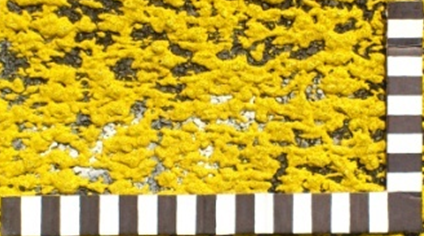
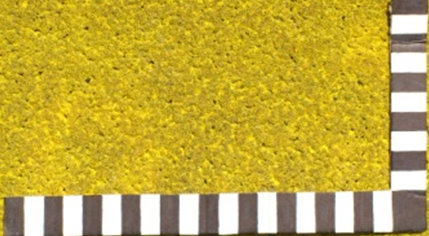
Image of a structural marking (left) and a color marking (right) on a quiet road surface in the canton of Aargau (Source: (Egger, Bühlmann and Gloor, 2017)1)
However, experiences have shown that structural markings can lead to complaints from residents, especially on new SDA 4 surfaces, as they cause audible increases in levels and frequency shifts. Measurements using the CPX method show that tire-road noise can increase by up to 6 dB(A). In contrast, pure color markings hardly lead to any change in tire-road noise. It should be noted that not all markings are equally relevant for noise generation. The more frequently a marking is crossed, the more relevant it is for noise generation. For example, pedestrian crossings or bus stop markings are crossed by every vehicle and are therefore more relevant than, for instance, the median strip, which is only crossed sporadically. Therefore, on SDA surfaces, color markings should be preferred over structural markings, considering safety requirements and their relevance for noise generation, whenever possible.
In the canton of Aargau, this is already being implemented, with structural markings used on SDA surfaces only in safety-relevant situations such as pedestrian crossings and center markings. All other markings are implemented as pure color markings.
Currently, the acoustic effects of markings are still being measured. The evaluation of the measurement data is currently in progress.
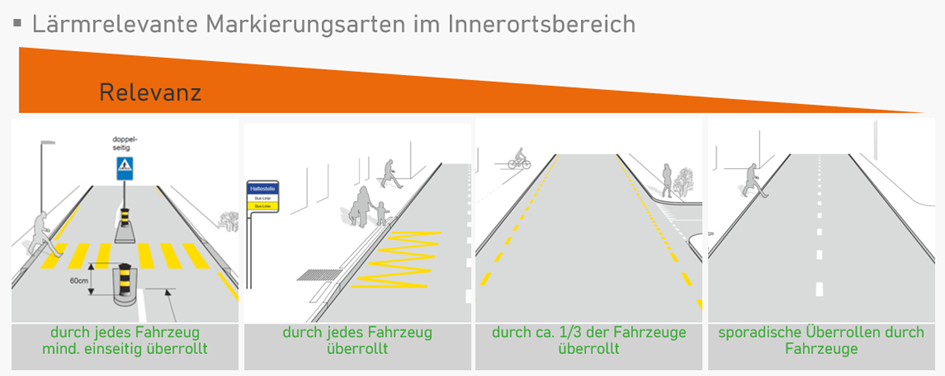
Various markings and their relevance for noise generation