
Development and Standardization in Switzerland
More than five decades of research have led to a continuous development of low-noise road surfaces in Switzerland. While open-porous asphalts laid the foundation for noise-reducing pavement technologies, the development of semi-dense asphalts (SDA) marked a significant advancement towards sustainable and durable solutions. Today, SDA pavements – particularly type SDA 4 – are considered a proven standard measure for reducing traffic noise in urban areas. With over 2500 installations, they demonstrate their high practical utility and established role in Swiss noise protection.
The ongoing adjustment of technical standards and the optimization of mix designs show that a balance between acoustic effectiveness, mechanical durability, and cost-effectiveness will continue to be pursued in the future. The goal remains to determine the optimal void content that ensures maximum noise reduction and lifespan with minimal porosity.
The standardization of SDA began in 2013 with SNR 640 436 (VSS, 2015), which was developed simultaneously with the standard SNR 640 425 (Swiss Association of Road and Traffic Experts VSS, 2019a), in which the acoustic performance requirements for low-noise pavements were established. Based on feedback from practice, the standard was updated in 2015, 2019, and 2021/2022 (Swiss Association of Road and Traffic Experts VSS, 2022d).
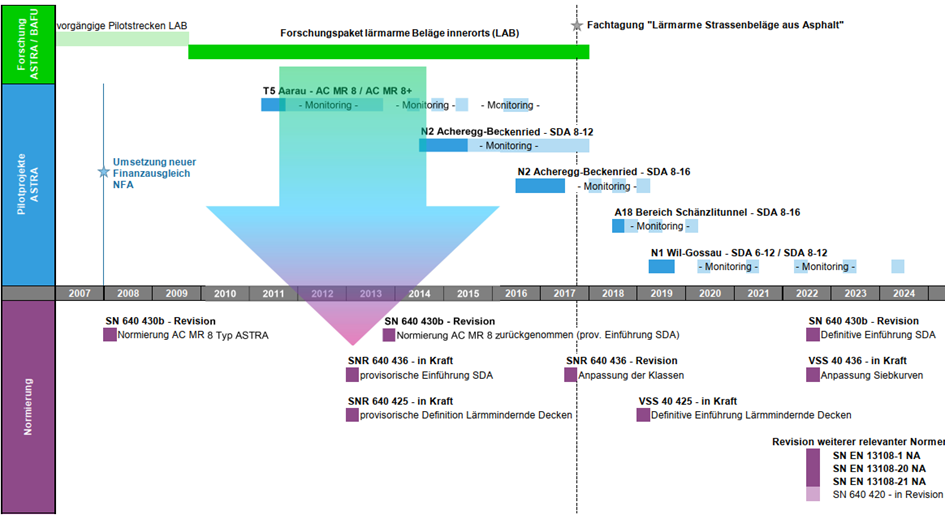
History of the SDA standard by ASTRA (Würmli, 2023)1
In the SN standards, the designations of the semi-dense mix types have been adjusted in recent years. The term LNA (Low Noise Asphalt) was followed by SDA (semi-dense asphalts) with types A, B, C, and D. Later, the SDAs were reclassified with a void range (e.g., SDA 4-12).2
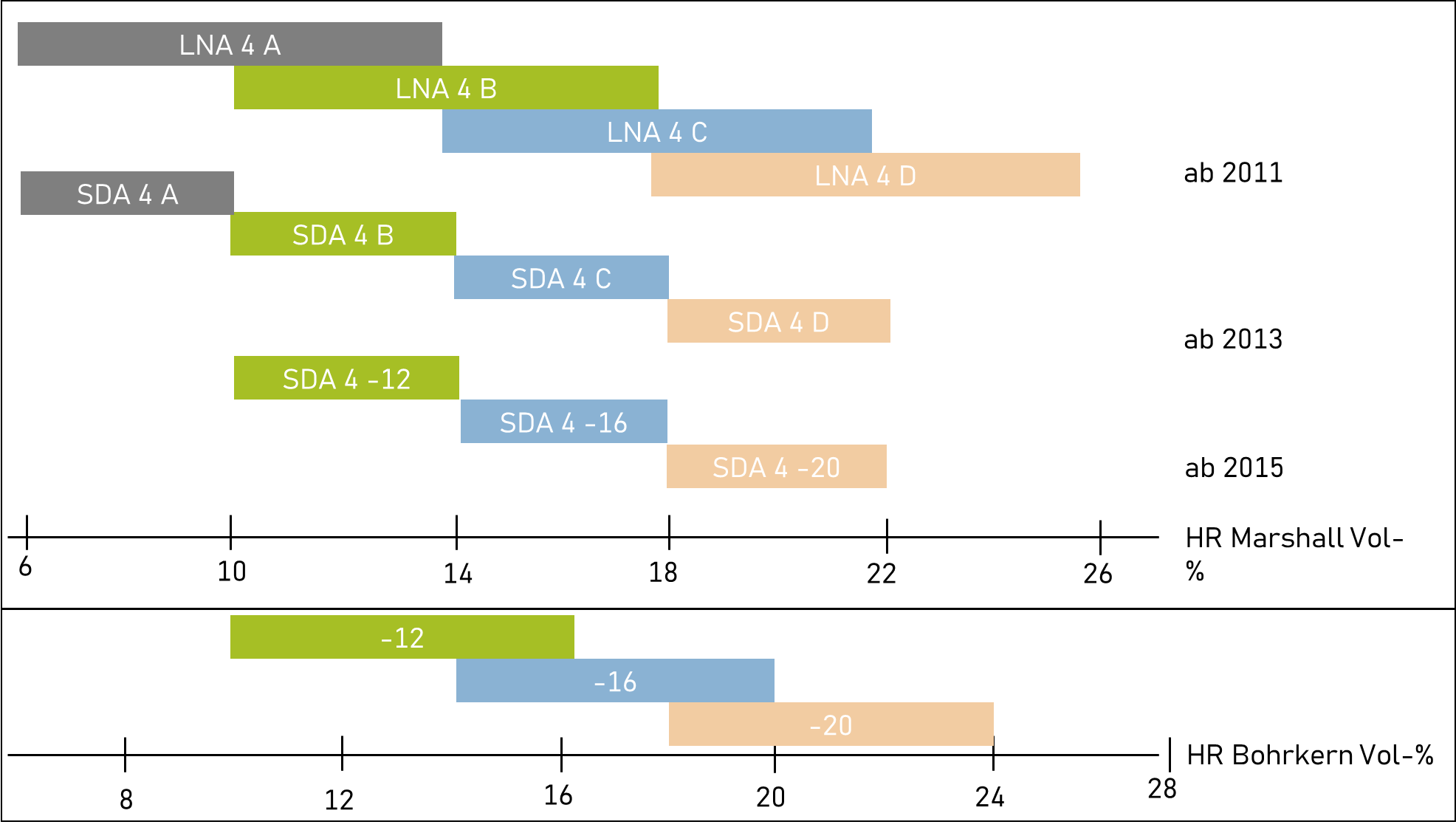
History of the designation of SDA 4 pavements (Source: Grolimund+Partner AG)
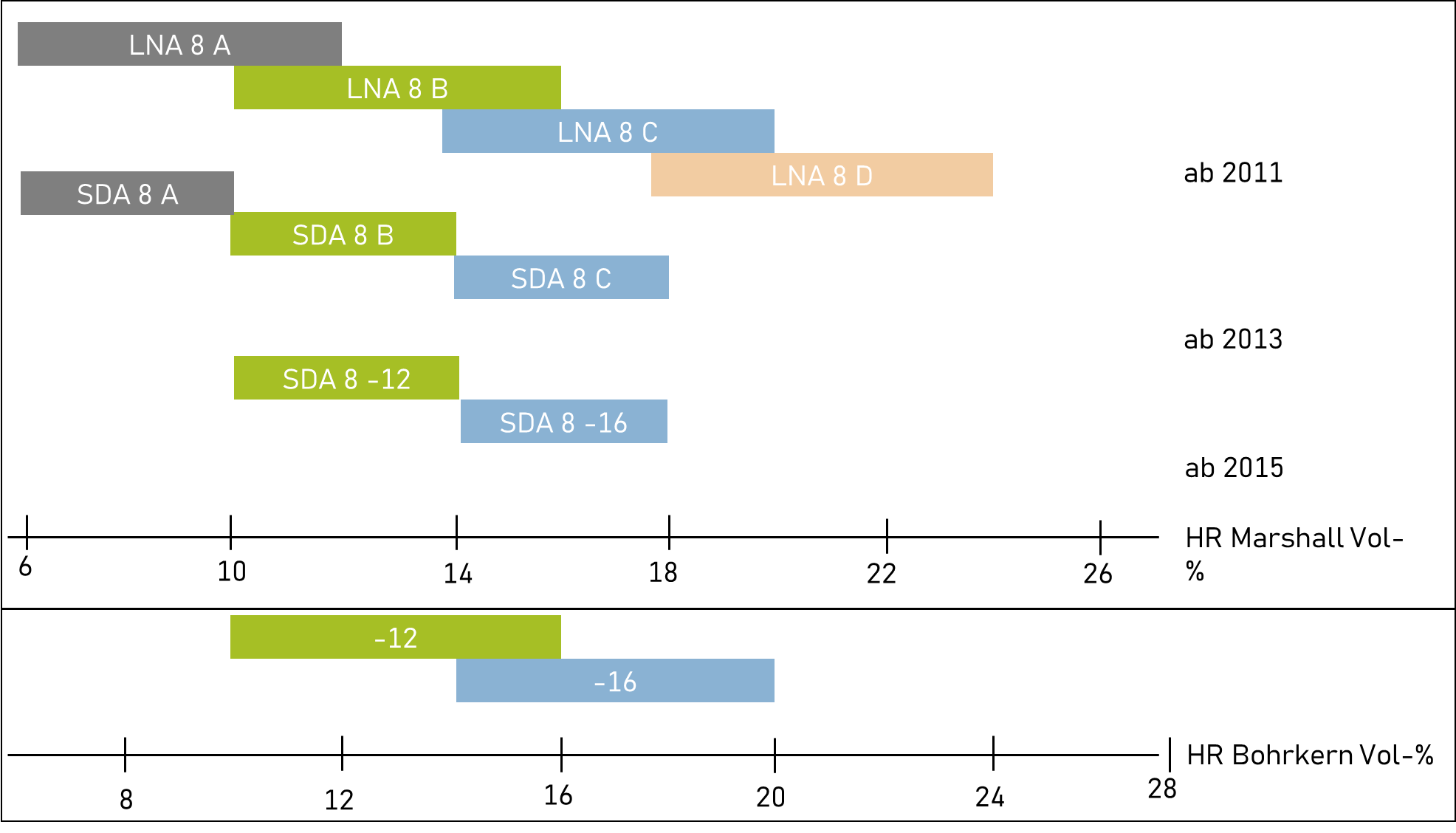
History of the designation of SDA 8 pavements (Source: Grolimund+Partner AG)
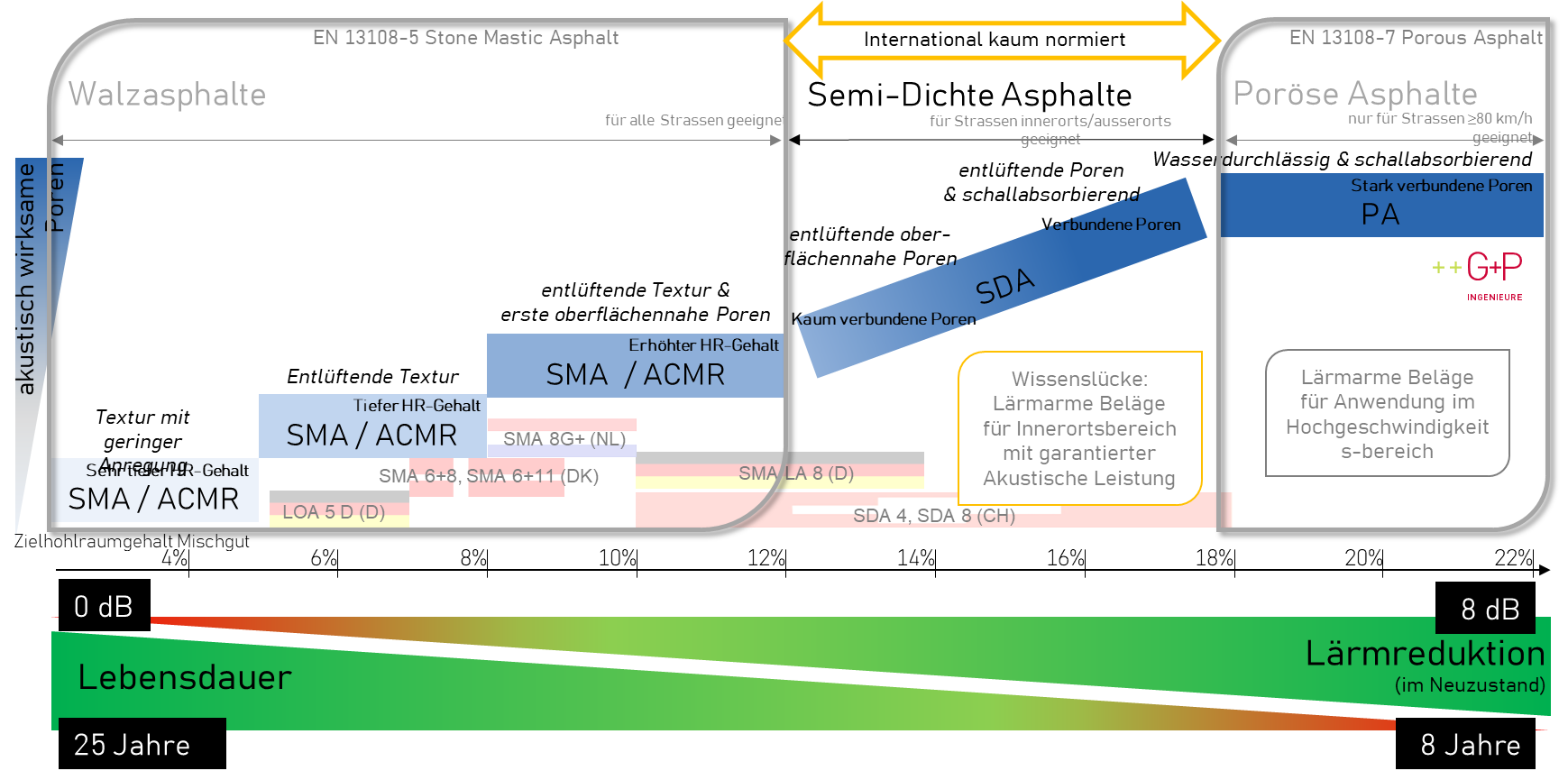
SDA in the context of asphalt standardization (Source: Grolimund+Partner AG)
Learn more about the history of SDA pavements
Since the 1970s, intensive research has been conducted in Switzerland on the development of noise-reducing road surfaces to reduce the increasing burdens of road traffic noise. The aim of this research was to achieve an optimal balance between acoustic effectiveness, mechanical durability, and traffic safety. Key approaches include open-porous asphalts as well as optimized concrete and semi-dense asphalt pavements.
A significant milestone was reached in 1972 with the first use of an open-porous asphalt on an airport runway in Switzerland. In the late 1970s and early 1980s, this technology increasingly found application on regular roads. In 1982, ETH Zurich initiated a comprehensive study in which open-porous pavements with void contents between 14% and 21% were examined at 17 locations (Isenring, Köster & Scazziga, 1990)3. The results showed that these pavements achieved a significant noise reduction at high driving speeds, while their benefit in urban areas remained limited.
Challenges and limitations of open-porous asphalts
A serious problem was the limited durability of open-porous asphalts. The use of sand for de-icing led to rapid clogging of the pores, significantly impairing the acoustic effectiveness. After a service life of five to six years, many of these pavements had to be replaced. These experiences made it clear that, in addition to acoustic performance, mechanical and weather resistance also needed to be more strongly considered. Accordingly, the focus of research increasingly shifted to questions of long-term performance, material composition, and the influence of climatic conditions on acoustic durability.
Moreover, economic aspects came to the forefront. Despite the high initial effectiveness in noise reduction, the cost-effectiveness of open-porous asphalts was critically discussed due to their short lifespan. This led to the search for alternative concepts that could combine sustainable noise reduction with improved durability.
Technological developments in the 1980s and 1990s
The further development of noise-reducing pavements in the 1980s and 1990s was closely linked to advances in binder technology. In particular, the use of polymer-modified bitumen (PmB) opened up new possibilities to increase the resistance of pavements to aging and mechanical stress. On this basis, the so-called semi-dense asphalts (SDA) emerged, which proved to be particularly suitable for use in urban areas. They combine effective noise reduction with a significantly higher lifespan compared to open-porous systems.
Development and establishment of semi-dense asphalts (SDA)
In the 1990s, research and development increasingly focused on low-noise pavements that remain effective even at low driving speeds and under urban conditions. While early approaches were based on dense pavements with optimized surface texture, a research project initiated in 2003 by the Federal Office for the Environment (BAFU) and the Federal Office for Roads (ASTRA) showed that semi-dense asphalts (SDA) with medium void content represent the most effective solution (Pestalozzi, Grolimund & Angst, 2004)4. These pavements enable significant noise reduction while also exhibiting high mechanical durability (Angst et al., 2008)5.
The acoustic and mechanical performance of SDA pavements depends particularly on the coordination between binder, grain structure, and compaction degree. Studies have shown that by specifically adjusting these parameters, both durability and acoustic effectiveness can be improved. For many Swiss cantons, SDA pavements thus offered a cost-effective and technically robust solution for reducing traffic noise in residential areas.
Standardization and practical application
Between 2011 and 2016, SDA pavements were systematically investigated at 15 locations in Switzerland as part of an extensive research program by BAFU and ASTRA. Based on these findings, the first standardization took place in 2015 through the VSS standard 40 436 (VSS, 2015). This standard specified requirements for composition, production, and installation, enabling the nationwide introduction of SDA pavements and a uniform quality assurance.
Further investigations – including by Bühlmann et al. (2017)6 – dealt with the acoustic long-term effect and the variability of performance between different locations. Based on this, additional material and installation parameters were identified that contributed to improving durability and acoustic stability. The resulting revision of the VSS standard in 2022 defined new design criteria to optimize the acoustic long-term behavior (VSS, 2022d).