
Effective acoustic effects
Acoustic Effects CH
Project CPX Measurements Road Surfaces Report BAFU
On behalf of the Federal Office for the Environment (BAFU), the acoustic effect of various road surfaces in Switzerland is being investigated to close knowledge gaps regarding aging behavior and the suitability of low-noise surfaces (LAB). The study includes low-noise surfaces (SDA 4 and SDA 8), conventional asphalt concrete surfaces (AC), and transitional surfaces. The aim of the project is to create a scientifically sound decision-making basis for the selection of suitable construction methods on specific road sections based on long-term measurement data and new results.
The acoustic quality of the surface is determined using the CPX method, which allows for continuous recording of noise emissions along entire routes. The measurement concept was developed in collaboration with BAFU and is based on existing datasets from G+P AG.
The investigation focuses on the following core questions:
-
the long-term effect of SDA 4 and SDA 8 surfaces,
-
the influences of traffic loads and climatic conditions (altitude) on their acoustic performance,
-
as well as the comparison of SDA, AC, and transitional surfaces regarding their long-term acoustics.
The results will be published regularly. A further comprehensive report will be released at the end of 2025.
CPX Measurements Road Surfaces: Report 2024
CPX Measurements Road Surfaces: Report 2024 - Appendix
Contribution EuroNoise 2016
Milestones in establishing low-noise asphalts as a widely used, effective, and durable measure for noise reduction in Switzerland
Acoustic Effects SDA Kt AG
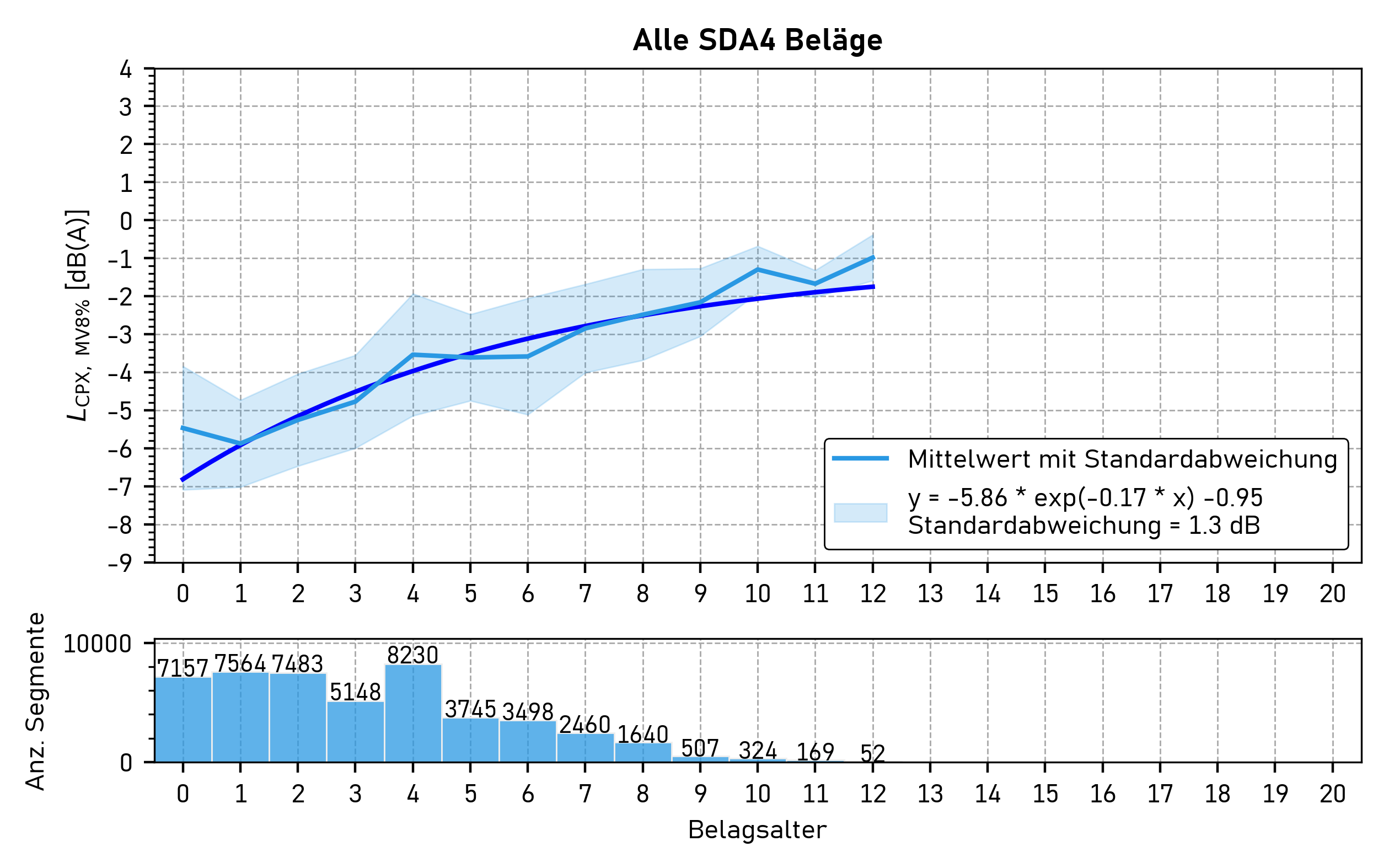
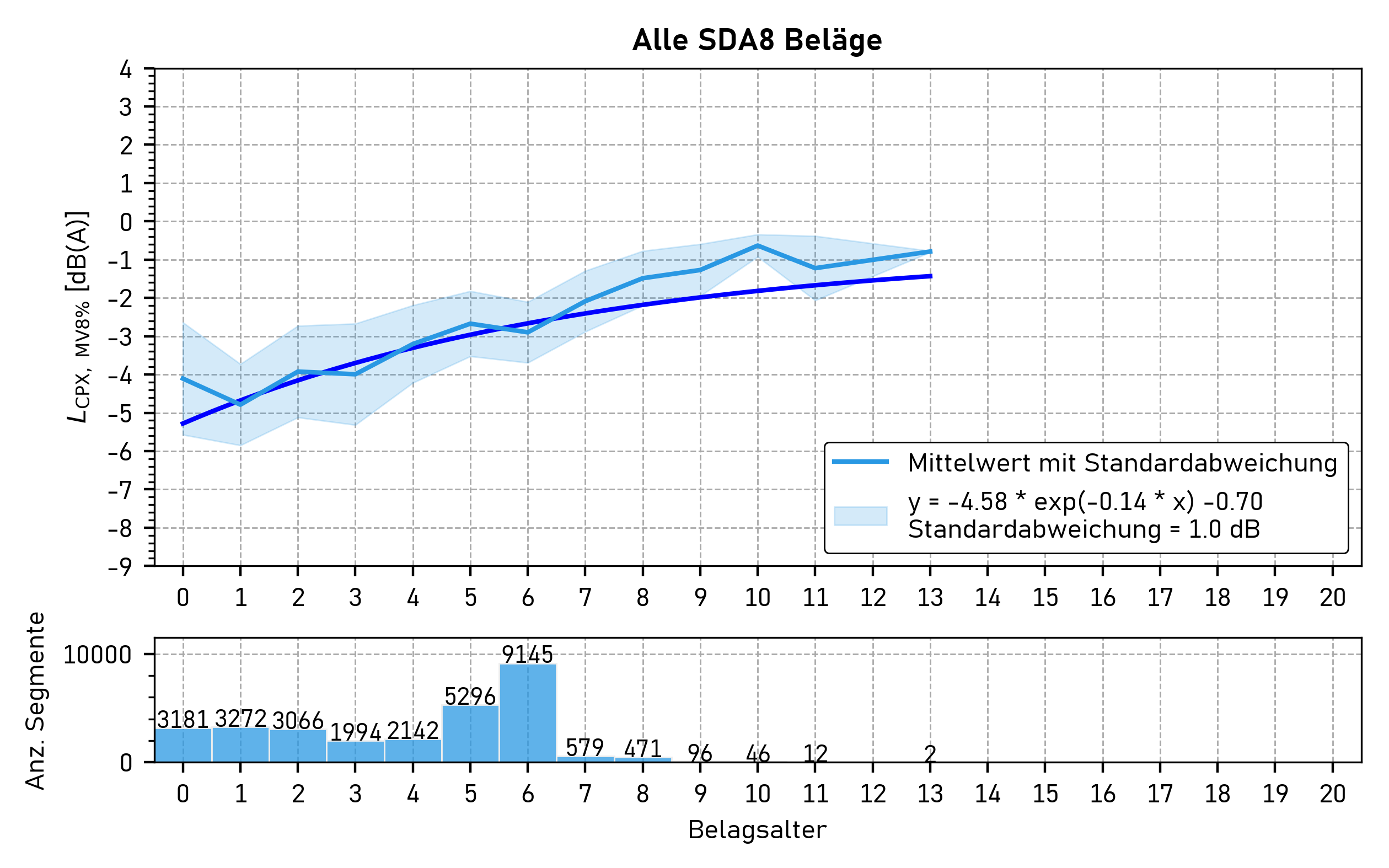
In the canton of Aargau, all SDA surfaces are subjected to acoustic monitoring. The following figures show the acoustic averages for mixed traffic 8% per surface age in years. The logarithmic aging curve was calculated as follows:
𝑦 = 𝑎 ∗ 𝑒𝑏∗𝑡 + 𝑐
Here, c is the acoustic end value, a is the difference between the acoustic end and initial value, b is the curvature of the curve, and t is the surface age.
Note 1: the figures are based on the data basis as of the end of 2024 (measurement data from monitoring and condition assessment)
Note 2: the columns show the number of segments considered per surface year (1 segment = 20m)
Acoustic Effects SDA other Cantons/Cities/Municipalities
Data from other cantons/cities/municipalities is welcome and desired.
Influence of Acoustic Aging
The acoustic effect of SDA surfaces decreases, as with all other surfaces, with increasing age due to traffic loads and other environmental influences. The following two processes play a significant role:
- The pores, which are so important for sound absorption, become increasingly clogged due to the entry of dirt, and the accessible cavities gradually close. This leads to an increase in tire-road noise in the mid and high frequency range.
- The SDA surface becomes rougher due to chip breakage, and the surface texture changes. This leads to an increase in tire-road noise in the low frequency range.
These two developments reduce the acoustic performance. The influencing factors on the acoustic aging behavior can be summarized as follows:
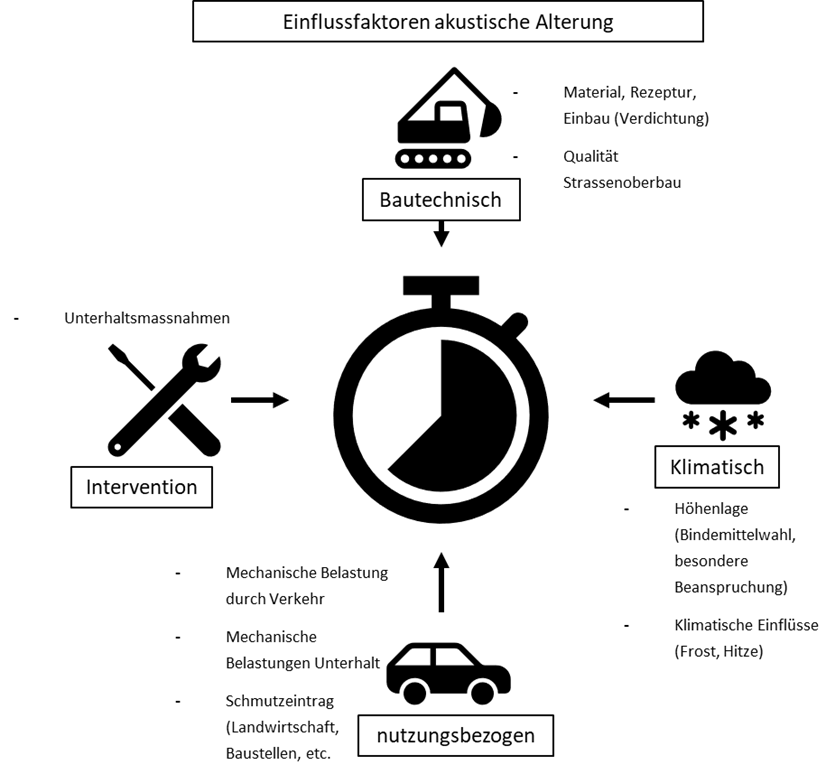
Overview of influencing factors on acoustic aging, not exhaustive (Source: Grolimund + Partner AG)
The statistical analyses of a study conducted in 2015 (Bühlmann, Dias and Steiner, 2015)1 identified three main influencing factors for acoustic aging:
- A high number of frost cycles increases the risk of performance loss the most due to strong stress.
- With increasing traffic load, quiet road surfaces also lose their effectiveness somewhat faster due to strong stress. However, the proportion of heavy traffic is more relevant than the total traffic load.
- High dirt entry shows an influence, for example, due to agriculture or construction activity. According to new results from the study conducted in the canton of Aargau on dirt and cleaning, dirt entry (and the associated loss of effectiveness) is part of the normal aging of quiet road surfaces.
The acoustic effect and the acoustic aging behavior of road surfaces also depend on many other factors such as mixture composition, compaction, and surface texture.
Acoustic aging can be delayed with specific maintenance measures, or the acoustic lifespan can be extended.