
Surface transitions
The emission differences between quiet and conventional surfaces can be up to 10 dB(A). Although residents in the transition area also benefit from a noise reduction, abrupt level changes occur at the transition, which can be perceived as very annoying. Based on a noise propagation model, it was estimated how far these abrupt level increases are perceivable (Egger, Bühlmann and Gloor, 2017)1 .
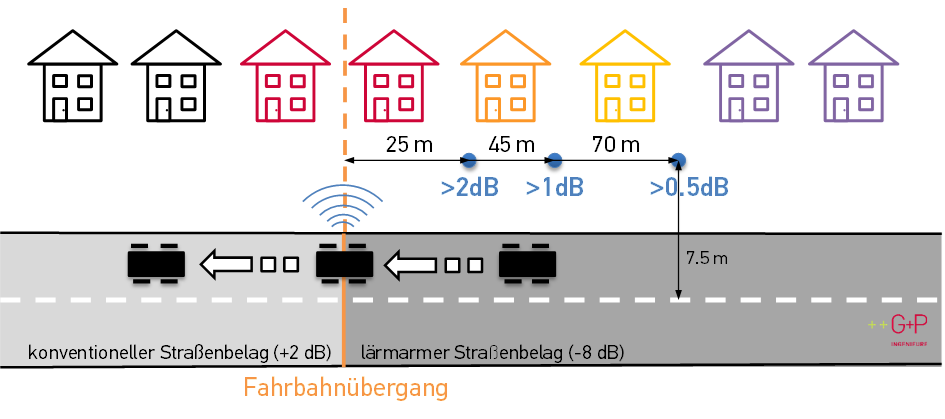
Immission-related acoustic effect of a road transition from a quiet to a conventional road surface. (Source: Egger, Bühlmann and Gloor, 20172 )
The effect is very clearly perceivable at a distance of 25 m from the road transition with >2 dB. Perceivable level increases are expected up to about 45 m from the transition (level differences of >1 dB(A) are generally considered perceivable). Since frequency shifts also occur simultaneously, which increase annoyance, the distance between the transition and the property should be at least 70 m if possible. Where this is not feasible, a transition area with a medium noise effect (e.g., AC 8) should be implemented to mitigate these effects.
In the canton of Aargau, efforts are already being made to counteract this problem and relieve residents of properties at the edge of quiet surfaces. The current approach is to extend the quiet surface across the inner/outer boundary. This places the transition from quiet surface to conventional surface at least 30 m away from the last property or the construction zone boundary.